Most shipwreck gold is anonymous. It comes up bright and heavy and tells you nothing about the person who was carrying it. This one is different. Somebody put a name on it.
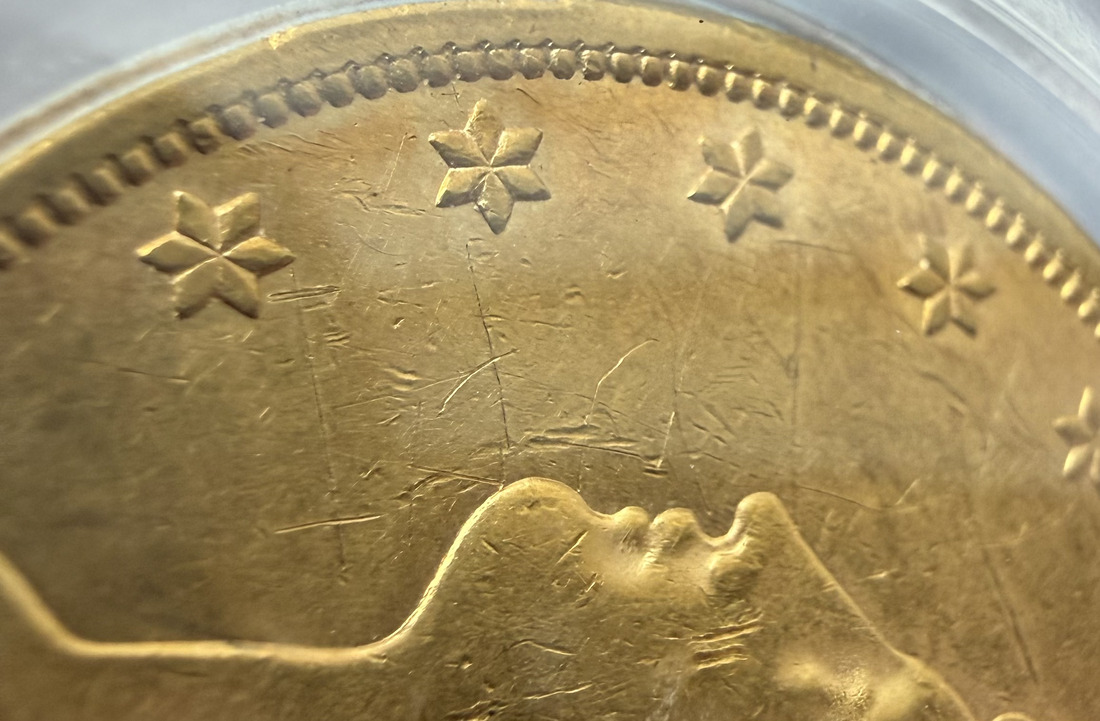
Cut into the obverse field, ahead of Liberty's face, are three letters scratched by hand into the metal: I-D-A. Not a mint error, not sea damage, not something a conservator did in 1996. Somebody sat down with a sharp point and put a name on twenty dollars of gold, which in 1865 was real money, and then that coin went into the Pacific with a steamer full of people.
Among the roll of the lost that day was a little girl named Ida.
The Scratch
Grading services do not like graffiti. A coin with something scratched into it gets no number, only a details grade and a reason code, and it takes a real haircut in price for it. This piece came back from PCGS as Genuine, Graffiti - AU Details, with the S.S. Brother Jonathan attribution printed on the label.
Under the scratches, though, the coin is almost new. The 1999 auction catalog that first offered it described it as net AU-50 with the sharpness of AU-58 - a coin that had barely circulated before it went to the bottom. Very little wear, sharp hair curls, full stars. Whoever owned it had not spent it much.
So the marks are not the abuse of a coin worn out in commerce. They are deliberate. On a piece of gold that fresh, in a year when twenty dollars was better than a month's wages for most working people, you do not idly carve a name. You do it because the coin means something - a gift, a keepsake, a stake set aside for someone.
The Ship
The Brother Jonathan was a wooden sidewheel steamer working the coast run between San Francisco and Portland, a hard, profitable route in a decade when the Pacific coast was still stitched together by paddle wheels rather than rails. She had been rebuilt and strengthened, and she was reportedly loaded well past what her master wanted to carry.
On July 30, 1865, out of San Francisco and beating north into a heavy northwest gale, she could not make headway. The decision was made to turn back for Crescent City. On the way in she struck an uncharted rock on St. George Reef - a shelf of submerged granite that the Pacific keeps hidden most of the time and that would eventually justify one of the most expensive lighthouses ever built in the United States.
She went down in under an hour. Of roughly 244 people aboard, one lifeboat got clear with nineteen in it. Everyone else was lost. It remains one of the worst maritime disasters in the history of the California coast.
The Roll of the Lost
The catalog compiler in 1999 noticed the same thing anyone notices. He went looking through the passenger list, and he found a name: Ida Thornton, daughter of Mrs. Cecelia Thornton. The mother was aboard too. Both are on the roll of the lost.
To his credit, he refused to make more of it than the evidence allowed. His note says outright that there is not even a strong possibility the two are connected - only that the remote chance exists, and that the chance alone is enough to add something to the lot. He also observed, drily, that it would not have been good form for little Ida to scratch up such a nice coin.
That is where the record stops, and it stops hard. Right now I have two names, a relationship between them, and the fact that neither came home. No ages. No photograph. No hometown, no destination, no reason for the voyage. A mother and a daughter, listed and lost, and then nothing.
Down, and Back Up
The hull sat off Point St. George for 128 years. She was found in 1993 in roughly 250 feet of cold, current-swept water, and worked in 1996 by Deep Sea Research after a long fight over who owned what came out of her. The gold recovered from the wreck - mostly 1865-S Double Eagles, with a scattering of earlier dates like this Philadelphia 1861 - was sold at public auction in 1999.
This coin was lot 108 in that sale, carrying Brother Jonathan inventory number 109. It has been in a holder since. The scratches look today exactly as they looked when the coin went over the side, because seawater at that depth is patient but not especially cruel to gold. Silver corrodes. Iron becomes concretion. Gold just waits.
Crescent City never let the wreck go. Sixty-six of the recovered dead are buried together in the Brother Jonathan Memorial Cemetery near the waterfront, some named and some not. The reef itself got the answer the town had been asking for since 1865: the St. George Reef Lighthouse, begun after the disaster and lit in 1892, built on a bare rock seven miles offshore at a cost many times that of an ordinary light and still counted among the hardest construction jobs ever attempted on the American coast. The ship's bell, her wheel, and a piece of her gold are on display at the Del Norte County Historical Society museum downtown.
What I Do Not Know
I am not going to tell you this was her coin. I do not know that, and neither does anyone else. It is entirely possible that some miner named it for a wife in Sacramento, or that a bank teller in Portland scratched an initial-and-name to mark a coin he was holding back, and that the Ida on the metal and the Ida on the passenger list never had anything to do with each other.
What I can say is narrower and, to me, better. On one ship, on one morning, there was a coin with a girl's name cut into it and there was a girl with that name. Both went into the same water. One of them came back.
The next step is the archive: Crescent City and Del Norte County records, the 1865 California and Oregon newspaper accounts and their published casualty lists, the 1860 census for Thornton households on the coast, and whatever survives of the Pacific Mail-era passenger manifests. If anything turns up on Cecelia and Ida Thornton, it will be posted here and the coin's page will be updated with it.
And if you are reading this because a Thornton is in your family tree, or because you have handled Brother Jonathan material and know something about lot 108 that I do not, I would genuinely like to hear from you. The coin is easy to research. The people are the hard part, and they are the part that matters.