The silver began as money, crossed the Pacific in a German warship, survived a two-hour gun duel, and came ashore as a trophy. In 1918, W. Kerr of Sydney turned it into something else: a medal that carries both ships on its face.
The Raider
When war reached the Pacific in August 1914, SMS Emden was a Dresden-class light cruiser in Germany’s East Asia Squadron. Captain Karl von Müller took her into the Indian Ocean as a lone commerce raider. A false fourth funnel helped her pass at distance for a British cruiser; wireless discipline, speed, and deception did the rest.
In barely three months, Emden captured or sank more than twenty Allied merchant vessels, shelled the oil tanks at Madras, and entered Penang harbor to destroy the Russian cruiser Zhemchug and French destroyer Mousquet. Von Müller’s habit of removing crews before sinking prizes gave the raider a reputation for restraint, but there was nothing bloodless about the war closing around her.
Cocos Islands
Before dawn on 9 November, Emden approached Direction Island in the Cocos (Keeling) group. A landing party went ashore to demolish the cable and wireless station—the communications link that could betray German movements across the Indian Ocean.
The warning escaped first. The station transmitted that an unknown warship was off the island before Emden could silence it. The message reached a nearby Australian troop convoy. HMAS Sydney, a newer and faster light cruiser with heavier guns, was detached to investigate.
The Duel
Sydney sighted the German cruiser shortly after nine in the morning. Emden opened fire first and found the range quickly, but the Australian ship could stand beyond the reach of the German 10.5-centimeter guns and answer with 6-inch shells. Sydney used that advantage methodically.
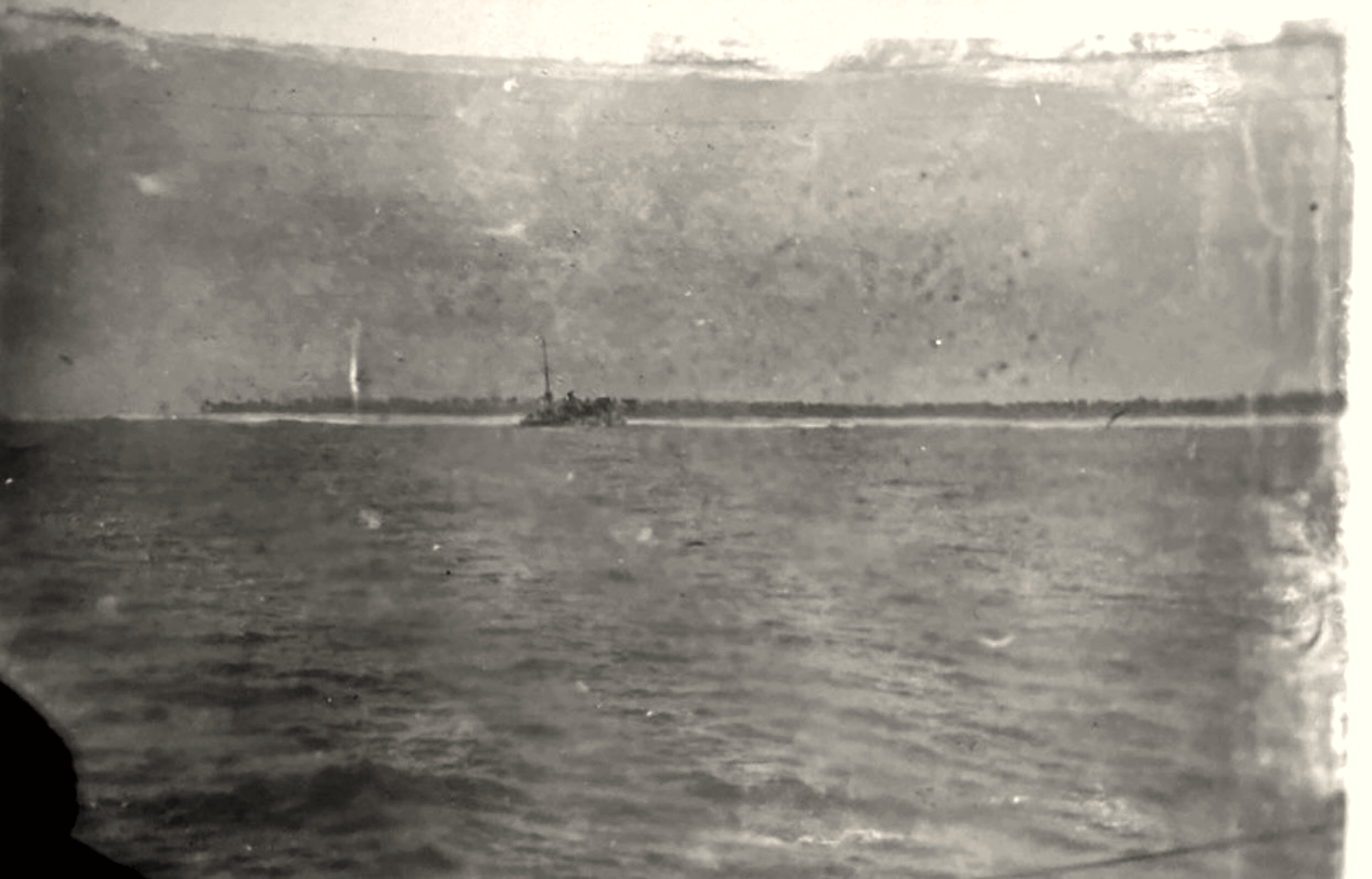
Shells tore through Emden’s funnels, steering gear, guns, and upper works. With the ship burning and control slipping away, von Müller drove her onto North Keeling Island to keep her from sinking. Approximately 130 German sailors were killed and around 65 wounded. Four Australians were killed and at least twelve wounded.
Sydney left briefly to pursue Emden’s collier, Buresk. On returning that afternoon, she found the German ensign still flying. Signals brought no clear surrender. Captain John Glossop ordered two more salvoes; only then was the ensign lowered and a white sheet raised.
The Men Who Got Away
The battle did not end every German journey that morning. Lieutenant Hellmuth von Mücke’s landing party watched from Direction Island as Emden was destroyed. Before Sydney could return for them, the men seized the schooner Ayesha and sailed away.
The escape became an odyssey: Padang in Sumatra, onward toward the Arabian coast, then by other vessels and overland after Ayesha herself was scuttled. The survivors eventually reached Constantinople and returned to Germany in 1915. Their ship had been lost, but its last detached command had escaped the battlefield.
Silver in the Strongroom
Salvage of Emden produced an unexpected treasury: 6,429 Mexican silver coins recovered from two safes. Most were 8 Reales pieces or pesos, the globally accepted trade silver that still circulated widely through China and the East Indies. They may have included both operational funds and money taken during the cruise.
The coins were not bullion when they entered the safes. Each had already lived a commercial life. The chopmarks on this example—small punches applied by merchants or money changers—are evidence of trust tested market by market. The wreck added a final, violent chapter to that circulation.
Spoils of War
In 1918, Sydney jeweller W. Kerr mounted 1,000 of the recovered coins as commemorative medals. The fitting bears the names HMAS Sydney and SMS Emden, fixes the date—9 November 1914—and turns the Mexican coin at its center into a literal spoil of war.
The medals were issued unnamed. Many recipients later added private engraving, but naming was not part of Kerr’s original issue. The pieces went to officers and ratings who had been present at the battle, next of kin, Cocos personnel, and institutions; a portion was also sold publicly.
Of the other unmounted coins, 653 were distributed with Navy authentication letters and 343 were sold to the public. The remaining 4,433 were melted at the Sydney Mint, with the proceeds given to the Royal Australian Navy Relief Fund. The exact date of that melting is not established in the sources used here.
The Medal
This example is certified by NGC as a 1914-dated Australia silver HMAS Sydney–SMS Emden Kerr medal, made with a Mexico 8 Reales. It is graded AU Details, Chopmarked, and carries certification number 2184798-001.
I collect objects that hold more than one history at once. This one does exactly that. It is Spanish-American trade silver, evidence of commerce in Asia, property recovered from a German raider, and an Australian memorial to the men who stopped her. The coin did not merely witness the aftermath. Its material became the remembrance.