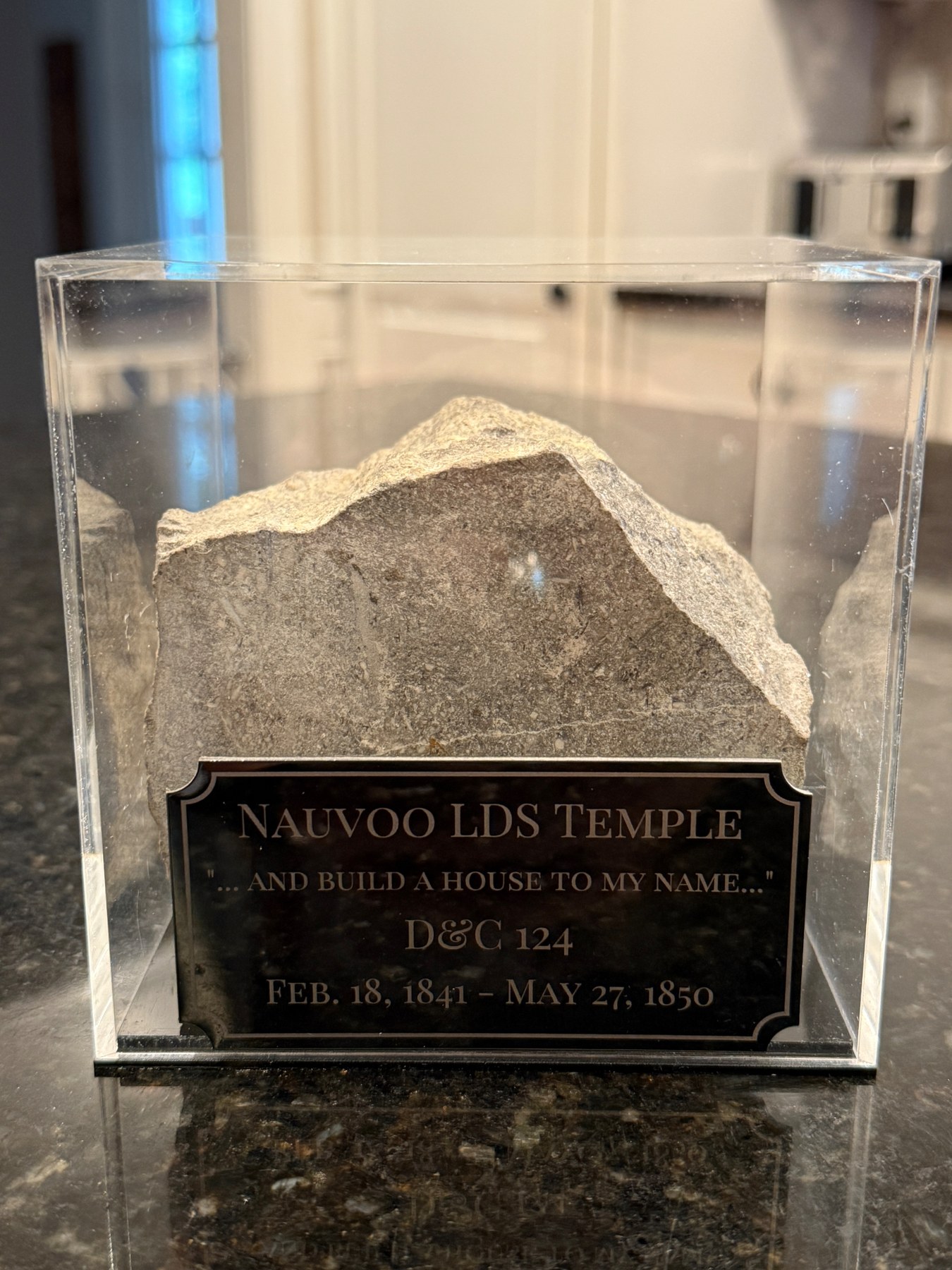
For as long as I can remember, this stone sat on my grandparents' mantle. It was not tucked into a box or brought out for special occasions. It simply lived there, steady and familiar, part of the room and part of the family.
After my grandmother passed away, it was left to me. Now it sits on my mantle. The distance between those two rooms is not very great, but the distance held inside the stone reaches across generations.
A House to My Name
In our family, this block has long been identified as limestone from the original Nauvoo Temple. That history comes to me through the family that preserved it. I do not have a surviving quarry record or an unbroken paper trail that follows this particular stone from the temple walls to my grandparents' home. Its provenance is the memory entrusted from one generation to the next.
The object itself is plain: gray limestone, broken rather than dressed, mounted on a black base and protected by a clear case. The plaque carries a line from Doctrine and Covenants 124: "...and build a house to my name..." Beneath it are the dates February 18, 1841, and May 27, 1850.
Those dates hold the life of the first temple at Nauvoo. Work began in 1841 with limestone quarried locally and shaped through years of sacrifice. The building rose above the Mississippi at a time when the people raising it were also building a city, enduring pressure, and preparing, though they did not yet know it, to leave both behind.
What Survived Nauvoo
By early 1846, the Latter-day Saints were leaving Nauvoo. The temple they had labored to complete remained behind, finished in limestone quarried nearby and raised by people who were already packing for the journey west.
Fire gutted the building in October 1848. A tornado struck the weakened walls in May 1850. What was left came down over the years that followed, and the cut stone was carried off: some into other buildings in the town, some into private hands, where a single block could become a keepsake rather than a wall.
A block like this carries two histories at once. There is the public history of the temple, recorded in plans, journals, dates, and photographs. Then there is the quieter history of possession: who kept an object, who placed it where children would see it, and who decided that it should remain in the family.
I cannot fill every gap in that second history. I can say what I know. It stood on my grandparents' mantle for as long as memory reaches. My grandmother kept it. She left it to me. I keep it now.
A Family That Kept Moving
The stone matters because my family's roots in The Church of Jesus Christ of Latter-day Saints run deep. The names and journeys in that history do not follow one road west. They cross an ocean, circle Cape Horn, stretch across the plains, and return again and again to the same act: answering a call without knowing exactly what the answer would cost.
One branch of my family came from England and reached California aboard the Brooklyn. Their story is told elsewhere in this archive in One Fare. 24,000 Miles. The ship left New York in February 1846 with Latter-day Saint emigrants aboard and sailed around Cape Horn, reaching Yerba Buena at the end of July. While most of the Saints moved west overland, they reached the West by sea.
Another ancestor was John Lowe Butler, born in Simpson County, Kentucky, in 1808. He joined the Church in 1834, then lived through the violence that met the Saints in Missouri. He was a principal participant in the 1838 conflict at Gallatin, an episode he later described in his own history as an attempt to protect his fellow Church members rather than take a life.
Butler later served missions in Illinois and among the Sioux, joined the Nauvoo Legion, and was appointed as one of Joseph Smith's bodyguards. His history and autobiography were published by historian William G. Hartley as My Best for the Kingdom. The title says plainly what his life demanded of him.
Crossing and Rescue
My third great-grandmother was Elizabeth “Betsy” Smith Goodwin. Born in Dundee, Scotland, on March 7, 1843, she was thirteen when she crossed the plains with the Willie Handcart Company in 1856. In a recollection published years later as “The Tired Mother: Pioneer Recollections,” she recorded what that crossing asked of her family.
Betsy sailed from Liverpool aboard the Thornton with her mother, Marjorie McEwan Bain Smith, her sisters, and her young brother. After landing in New York, they traveled to Iowa City. Betsy became gravely ill while the handcarts were being prepared, but recovered and left with the company on July 15. She remembered the rhythm of twenty-mile days, songs around the evening fire, and rations that grew smaller as the journey continued.
Then early winter closed around them. Snow and wind came before the company was safely through the mountains. Betsy's fingers froze as the flour ration dwindled, and her mother became dangerously ill with cramp and cholera. When Betsy feared she would die, her mother answered, “Do not feel like that. Pray for me.” Prayer, shared labor, and care for one another became part of how the family endured the crossing.
When word reached Salt Lake City, Brigham Young called for a rescue. Men, wagons, food, blankets, and teams were sent back onto the trail. Among the rescuers was my relative Ephraim Knowlton Hanks, a Mormon Battalion veteran and frontiersman remembered for answering that call and carrying food and aid toward the stranded emigrants.
One relative came forward with the handcarts. Another went back into the storm to meet them. Their places in the story are different, but the inheritance they leave is joined: endurance on one side, service on the other.
On My Mantle Now
Family history can become a list if we let it: names, dates, companies, crossings. The stone prevents that. It has weight. It occupies a place. It reminds me that faith was not an abstraction to the people who came before me. They built with it, sailed for it, walked for it, and turned back into danger for one another because of it.
I am grateful for my pioneer heritage. Not because every detail is complete or every family tradition can be reduced to a document, but because the inheritance is still here: in the stories, in the names, and in this rough piece of limestone that moved from my grandparents' mantle to mine.
Someday, I hope it will rest on another mantle. The room will change. The stone will not. And someone else in the family will know why it was kept.